
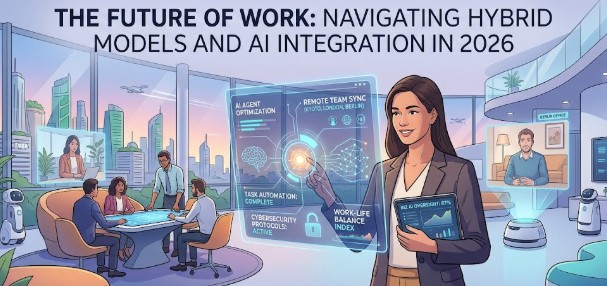
The definition of “the office” has undergone a radical transformation. As we move through 2026, the global workforce is no longer bound by physical geography or traditional 9-to-5 constraints. For digital publishers and entrepreneurs, understanding these shifts is crucial for staying competitive. This comprehensive guide explores how to adapt to the future of work in 2026 and the essential strategies for business automation.
1. The Paradigm Shift: Why 2026 is Different
By 2026, the transition from “digital-first” to “AI-native” workflows is complete. Work is no longer a place you go, but a series of value-driven tasks you perform within a global ecosystem.
-
Decentralized Teams: Talent is now sourced globally, making “timezone-agnostic” collaboration a standard requirement for successful startups.
-
AI as a Colleague: The rise of AI Agents means that humans are shifting from “doers” to “orchestrators”.
-
Skill-Based Hiring: Employers are prioritizing verifiable technical skills and adaptability over traditional degrees.
2. Emerging Professions: How Much Can You Earn in 2026?
As old roles become automated, new high-value professions are emerging. If you are looking for how to become an AI Automation Specialist or a Prompt Engineer, 2026 is your year.
AI Automation Specialist: How Much Does It Earn in 2026?
These professionals design the workflows that allow AI Agents to run businesses autonomously.
-
Earnings: In the 2026 market, senior specialists can command salaries significantly higher than traditional IT roles due to the direct impact on operational efficiency.
-
How to Become: Focus on learning LLM orchestration, no-code automation platforms (like Make or Zapier), and business process mapping.
Remote Collaboration Coordinator
With teams spread across continents, the need for experts who can manage digital culture and “virtual presence” is at an all-time high.
3. Top Trends Shaping the Future of Work
The Rise of the “AI Agent”
We are seeing a shift from passive AI tools to active AI Agents. These agents don’t just suggest text; they execute transactions, manage customer support, and optimize SEO strategies for sites like Blogheaders.com.
Hyper-Personalized Employee Experiences
In 2026, the “one size fits all” HR model is dead. AI-driven platforms now tailor benefits, learning paths, and work schedules to individual employee needs, leading to record-high retention rates.
Sustainable and Ethical Work
Workforce decisions are increasingly driven by ESG (Environmental, Social, and Governance) scores. Transparency in how AI is used and the carbon footprint of digital operations is now a major competitive advantage.
4. How to Future-Proof Your Business in 2026
To ensure your business remains “evergreen” and continues to generate hits, follow these three strategic pillars:
-
Invest in AI Literacy: Ensure every team member understands how to leverage AI tools to double their output.
-
Adopt Asynchronous Work: Reduce meeting fatigue by utilizing video memos and collaborative documentation.
-
Prioritize Human Creativity: Use automation for the “robotic” tasks so your team can focus on high-level strategy and emotional intelligence.
Frequently Asked Questions (FAQ)
What is the most in-demand skill in 2026? The ability to collaborate with AI (AI Augmentation) is the single most important skill across all industries.
Will remote work continue to grow? Yes, but it has evolved into a “Hybrid-Intentional” model where physical gatherings are rare but highly strategic.
How can I automate my small business in 2026? Start by identifying repetitive tasks in your sales funnel or content production and deploying specialized AI Agents to handle them.